







|
HOTLINKS to download
PAVE reports, review
upcoming NCAT training courses, query historical weather
data, view current color radar or preview
local forecast.
1,673,674 ESALs as of 2300 hours on January 9, 2010 (17% of the 10,000,000
ESAL goal !). Rut depths measured on 12/14/09
averaged 3.3 mm, while roughness averaged 82.2 inches per mile.
CONTACT
this project via...
NCAT_Pavement_Test_Track
1600_Lee_Road_151 Opelika,_AL_36804_USA 334.844.7304

GOD BLESS AMERICA !
| |
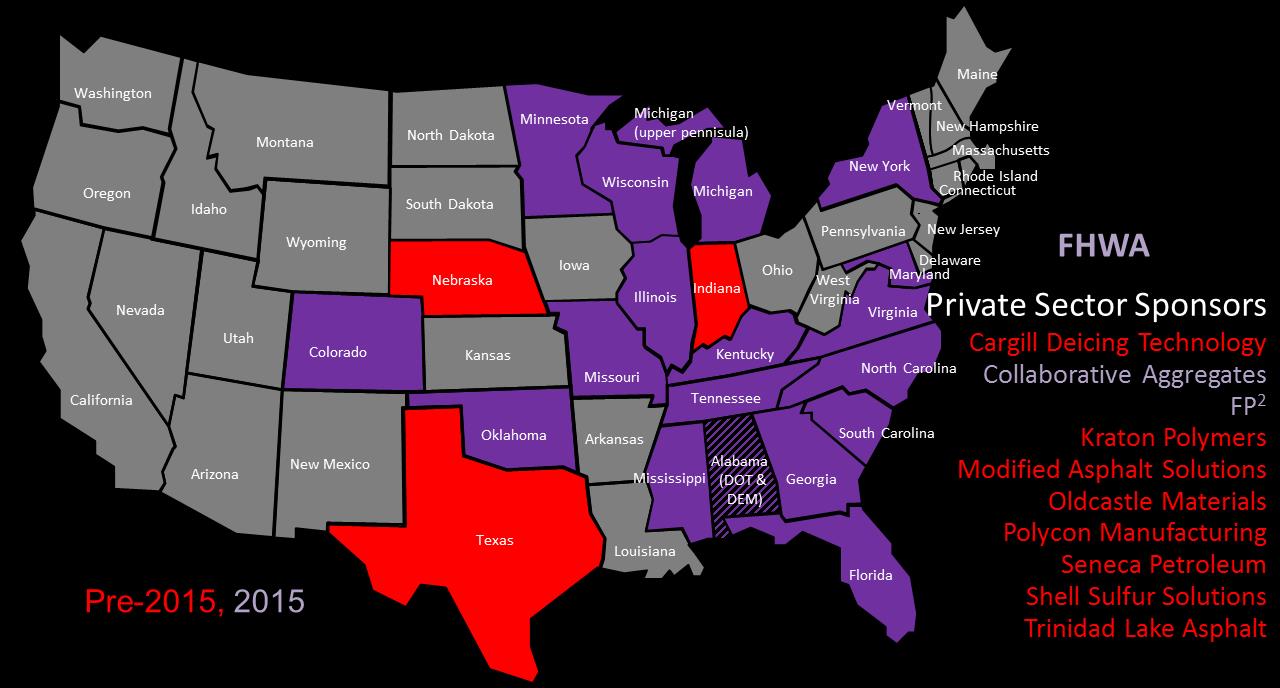
This project is as good an example of "partnering" as can be found.
The support of the Alabama DOT and individual
section sponsors provided the financial basis that made everything possible, but many
other groups were also involved in some way. Links to each pavement research sponsor
are provided below.
Section Sponsors
 | The Alabama Department of Transportation
(ALDOT) funded the original construction of the facility in 2000 to provide the overall
research infrastructure for future testing cycles. In the 2009 research cycle, ALDOT
is funding traffic continuation on structural sections from previous research cycles that
may be perpetual, as well as supporting the multi-section Group Experiment. They
have also been supportive of all the other sponsors by providing equipment and personnel
essential for monthly field performance testing on all 46 test sections. |
 | The Florida Department of Transportation
provided funding to sponsor 2 structural sections. Both sections are paved with mix
that was proven to be susceptible to surface cracking in the 2006 research cycle, and both
sections are built with the same porous friction course (PFC) surface; however, one was
paved with a spray paver and the other with conventional tack paving. They are also
supporting the multi-section Group Experiment. |
 | The Georgia Department of Transportation
provided funding to sponsor 1 mix performance section. Their objective is to assess
the performance of an SMA surface that was produced using aggregates that do not meet
their stringent flat and elongated quality requirement. |
 | The Mississippi Department of Transportation
provided funding to sponsor 2 mix performance sections in which they are studying the
performance of a gravel PFC surface and a high recycled content dense gravel mix.
The gravel PFC surface was placed back in 2006 and will be evaluated for both
functionality and durability. |
 | The Missouri Department of Transportation
provided funding for 2 mix performance sections. Their objective is to compare the
performance of a ground tire rubber (GTR) modified PG76-22 mix to an SBS modified PG76-22
mix, both containing exactly the same aggregate blend and volumetric design. |
 | The North Carolina Department of
Transportation provided funding to sponsor the multi-section Group Experiment. |
 | The Oklahoma Department of Transportation
provided funding to sponsor 2 structural sections in which they are studying perpetual
pavement design methodology. Both were initially placed back in 2006, with
rehabilitation of the thinner section required in 2009. Geotextile fabrics were
included in order to assess their effect on cracking recurrence. Assitionally, they
provided funding for the multi-section Group Experiment. |
 | The South Carolina Department of Transportation
provided funding to sponsor the multi-section Group Experiment. |
 | The Tennessee Department of Transportation
provided funding to sponsor the multi-section Group Experiment. |
 | The Federal Highway Administration provided
funding to support the multi-section Group Experiment, traffic continuation on a dual
layer PFC placed in 2006, and traffic continuation on high recycled content mixes placed
in 2006. Their participation is important to the overall project because they
continue to allow us to utilize the 3 surviving Westrack trailer trains to reduce our
trucking costs. |
 | Cargill provided funding for a surface performance test section treated with materials
that are intended to reduce the need for de-icing chemicals. |
 | Kraton Polymers provided funding for a thinner structrual test section built with highly
polymer modified asphalt whose performance can be compared to thicker sections in the
mutli-section Group Experiment. |
 | OldCastle Materials Group provided funding for the overall laboratory testing program as
a means to support traffic continuation on the high recycled content sections placed in
2006. |
 | Shell provided funding for 2 structural sections of different thicknesses produced with
their Thiopave warm mix sulfur process as a replacement for a portion of the liquid
asphalt binder. |
 | Trinidad Lake Asphalt (TLA) provided funding for 1 structural section that was produced
with TLA pellets as a replacement for a portion of the liquid asphalt binder. |
Material Suppliers
 | Boral Material
Technologies supplied the flyash that was used in the SMA and OGFC sections. |
 | Select unmodified and SBS-modified asphalt binders were purchased from Ergon. |
 | Hi-Tech Asphalt Solutions donated the cellulose fiber used to prevent draindown in OGFC
and SMA mixes. |
 | OldCastle Materials Group donated aggregates
that were utilized to produce mix for many test sections. |
 | Vulcan Materials Company donated aggregates
that were utilized to produce mix for many test sections. |
Equipment Suppliers
 | Equipment supplied by Astec was used to produce
every mix that was placed on the track. |
 | Ignition Furnaces manufactured by Barnstead |
Thermolyne were used to extract aggregate samples and monitor asphalt contents during
construction. |
 | Instrumentation components were purchased from Campbell
Scientific, who also provided a great deal of technical support before, during, and
after construction. |
 | CPN International donated the use of their rotary
loaded wheel tester for post construction performance testing of experimental mixes. |
 | Roadtec provided the lone paver used to place
experimental mixes, a material transfer device that was used to place every section, and a
milling machine that was used to remove old mixes. |
 | Transtech Systems donated the use of a PQI
Model 301 impedance density gauge that was used in conjunction with a nuclear density
gauge to monitor construction quality then document densification under traffic. |
Trucking Operations
 | Centramatic donated and supports mechanical
wheel balancers on the entire Track fleet. Additiionally, they provide useful
support to the trucking operation in many other ways. |
 | Dana / Eaton donated research axles for the
Track fleet as part of a comprehensive endurance test. |
 | FHWA made the trailers from the Nevada Automotive
Test Center available for use at NCAT. |
 | Wilson Oil supplies the fuel for the onsite fuel
tank. |
Please Notify of Errors and Omissions
Back to Top
|